ABOUT MOVERE JOURNAL
Retraction and Withdrawal Policy
Open Access,Copyright&Plagiarism
Article Processing Charges Policy (APC)

Movere Journal is a scientific journal published Sekolah Tinggi Ilmu Ekonomi Tri Dharma Nusantara, First published since 2019. Movere Journal contains articles in the form of research results (original research articles) and is a journal published twice a year by the Management Science Study Program, Sekolah Tinggi Imu Ekonomi Tri Dharma Nusantara. Movere Journal is an Open Access Journal (OJS) that provides journal articles that can be downloaded for free. Movere Journal aims to publish research articles in the fields of Economics, Management, Business and Entrepreneurship as well as related issues in these fields. Striving to present the results of scientific research from scientists, professionals, scholars, researchers to be published and disseminated through manuscript selection. Articles published in the Movere Journal (e-ISSN: 2656-2790) are articles that have gone through a review process by Peer reviewers.
The purpose of this journal is to provide a place for academics, researchers and practitioners to publish original research articles or review articles. The scope of articles published in this journal covers a wide range of topics, including:
Movere Journal is an open access journal. All published articles are freely available to readers worldwide without subscription or payment. Users are permitted to read, download, copy, distribute, print, search, link to, or use the full text of articles for any lawful purpose without prior permission from the publisher or the authors. This policy is consistent with the principles of the Budapest Open Access Initiative (BOAI).
Movere Journal publishes only original scholarly works that have not been previously published or simultaneously submitted to another journal. Authors are responsible for ensuring that their manuscripts are entirely original. Any use of the ideas, data, figures, tables, or words of others must be properly cited and acknowledged. Plagiarism in any form—including copying, paraphrasing without attribution, duplicate publication, self-plagiarism, or claiming the work of others—is considered unethical and will not be tolerated.
To maintain publication integrity, Movere Journal implements the following procedures:
Manuscripts that fail to meet Movere Journal originality standards may be rejected at any stage of the editorial process.
Authors retain the copyright of articles published in Movere Journal. By submitting and publishing their work in Movere Journal, authors grant the journal the right of first publication. Published articles are distributed under the Creative Commons Attribution 4.0 International (CC BY 4.0) License.This license permits anyone to share, copy, redistribute, adapt, and build upon the published work, including for commercial purposes, provided that appropriate credit is given to the original author(s), a link to the license is provided, and any modifications are clearly indicated.
Movere Journal is published 2 (twice) times a year, namely in January and July, containing writings/articles on the results of thought and research results written by experts, educators, scientists, practitioners. Movere Journal publishes research articles in the fields of human resource management, financial management, marketing management, strategic management, economics, business and entrepreneurship. For this reason, various article writers from within and outside the country were invited.
General Requirements
Rules and Systematics of Article Writing
Title: Maximum 15 words for Indonesian articles and 10 words for English articles. Title typed in Times New Roman letters, 14pt bold print.
Author Name: The name of the author or writer-authors is typed under the title in bold Times New Roman 12 font, without title and must not be abbreviated. Under the name is written: Affiliation of the authors: study program/department, name of institution and name of State. Below it is also written an email with a font size of 11pt.
Abstract: It must not be more than 300 words, written in English and Indonesian, in one paragraph containing: research objectives, research methods, analysis techniques and research results. Typed in Times New Roman font, single space. Below the abstract there are keywords of a maximum of 5 words, separated by commas, double-spaced under the abstract.
Introduction: The introductory title is typed in large letters Times New Roman font 12 bold. Contains the background, objectives of the research, the problems to be researched, the urgency and rationalization of the activities, the literature review, the problem-solving plan and the development of hypotheses [font Times New Roman, 12, normal].
Theory Overview: Contains theories relevant to research variables, as well as logical explanations of research phenomena that can be complemented by a conceptual framework.
Research Methods: The research method describes about: approach, scope or object, operational definition of variables/description of research focus, place, population and sample/informant, main materials and instruments, data collection techniques, and data analysis techniques.
This section explains the methods/approaches used, for example qualitative or quantitative research or mixed methods. Furthermore, it is explained the research steps that are carried out until data is obtained, for example using questionnaires or interviews or observations or all three, etc. so that the methodology is clearly drawn at this point.
Furthermore, explain the population and sample of the research carried out in detail, if necessary complete with population and sample tables or explained in detail so that it is clear who the population is, how many samples and how to determine the sample and the respondents/informants. If a sub-subject is needed, then the title of the sub-subject is written using the Times New Roman font with size 12, bold.
Results and Discussion: The results of the study are presented completely and according to the scope of the research. The results of the research can be supplemented with tables, graphs (images), and/or charts. Tables and figures are numbered and titled according to the conditions for writing tables, figures, charts and formulas. The results of the data analysis are interpreted correctly. The discussion section explains the results of the discovery logically, linking it to relevant reference sources. [Times New Roman, 12, normal].
Provisions for writing tables, figures and charts:
Rules for writing Symbols and Formulas: In general, writing symbols or symbols should use the letter "Symbol" or use the symbol insertion facility in a typing software (word processor). The units and abbreviations used follow the rules commonly used in scientific disciplines.
Equation writing uses the "Equation" insertion facility in a word processor. Each equation written must be numbered sequentially using Arabic numerals. The number of the equation is written in parentheses placed to the right of the equation and is parallel to the right margin. Examples of formula writing are as follows:
Y = a + bx1 + bx2 + e........................................................................................................... (1)
Conclusion: The conclusion contains a brief summary of the results of the research and discussion. Conclusion is a research finding in the form of an answer to a research question or research objective. The results of the research provide suggestions/contributions to the application and/or development of knowledge. Conclusions are made in the form of paragraphs instead of point points. [Times New Roman, 12, normal].
Bibliography: Contains the referenced sources and at least 80% in the form of libraries published in the last 5 years. A list of references of at least 15 pieces that prioritize references from Journals. The reference list is recommended to use the Mendeley application in the style of the American Psychological Association (APA) 7th edition. All sources listed in the bibliography must be in the article manuscript.
Jurnal Movere: menggunakan sistem double-blind untuk peer-review; identitas reviewer dan penulis tetap anonim. Makalah akan ditinjau sejawat oleh dua pakar; satu reviewer dari luar dan satu editor dari jurnal biasanya terlibat dalam peninjauan naskah. Jurnal akan menyaring makalah untuk plagiarisme menggunakan Google Scholar Check.
Semua manuskrip yang dikirimkan akan diperiksa oleh Editor Pengelola sesuai dengan Cakupan Penelitian, Pedoman Penulis dan Template Artikel. Semua manuskrip yang telah melewati pemeriksaan awal akan dilanjutkan untuk pemeriksaan plagiarisme yang tidak boleh melebihi 30% dari plagiarisme.
Semua manuskrip yang tidak memenuhi syarat dan sesuai dengan Cakupan Penelitian, Panduan dan Template akan dikembalikan untuk perbaikan atau diteruskan ke Tim Editorial untuk tinjauan ganda, yang biasanya memakan waktu sekitar satu hingga dua minggu untuk setiap review.
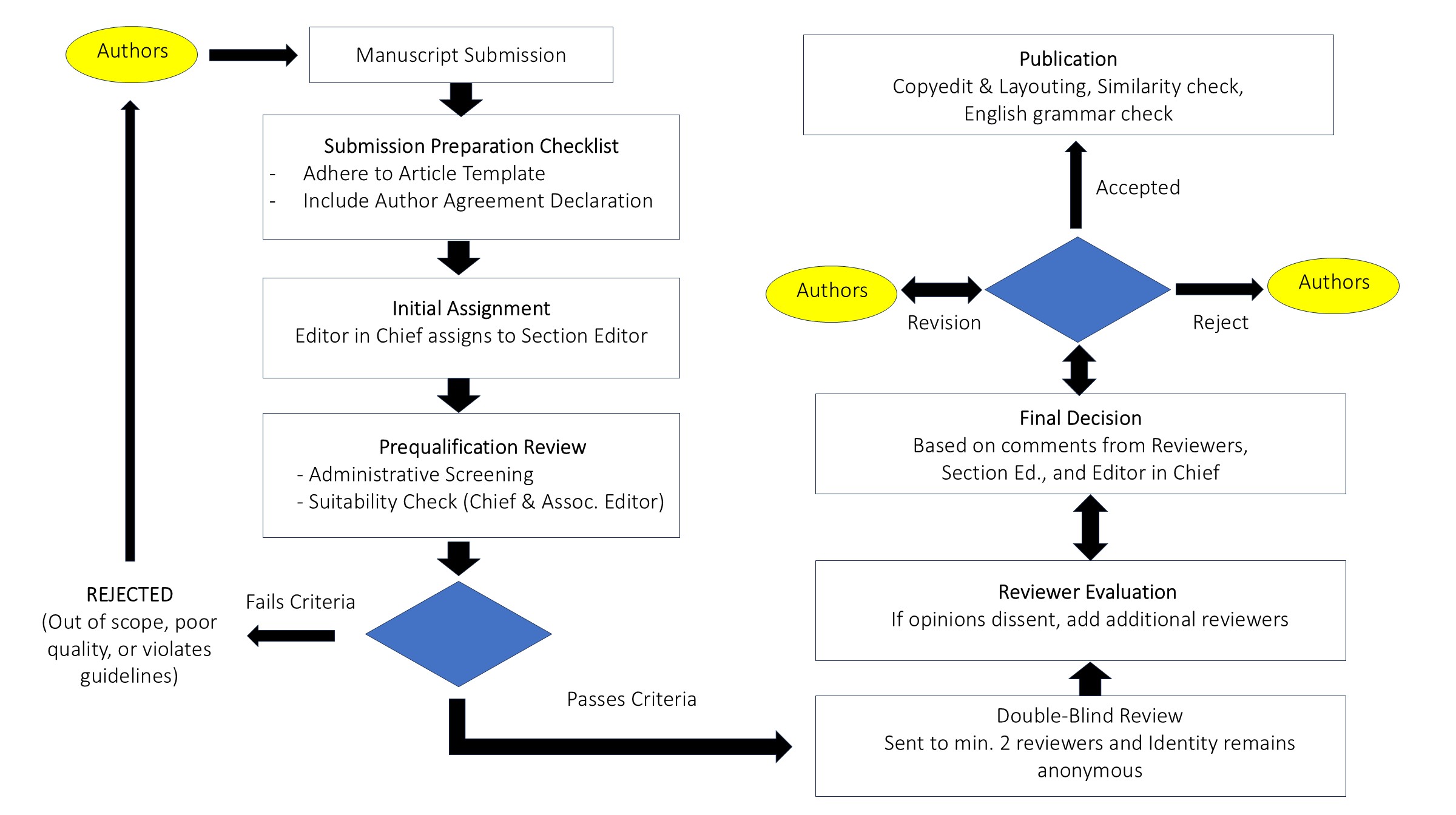
Editor in Chief will assign the manuscript to a corresponding section editor for further handling. The section editor will request at least two scientists to review the manuscript. All manuscripts are checked by qualified peer review and the authors are subject to blind peer review whose identities will remain anonymous. Based on the comments from the revieweres, Section Editor, and Editor in Chief will make the decision on the manuscript. For further information, please refer to the following:
1. Authors must follow the Submission Preparation Checklist, including the Article Template provided by Movere Journal, when submitting a manuscript. Additionally, they must submit the Author Agreement Declaration along with the manuscript.
2. The Editor in Chief will assign the manuscript to a corresponding Section Editor for further processing.
3. After passing administrative screening, the Chief Editor and Associate Editor will conduct a prequalification review of the submitted papers to determine their suitability for further review.
4. Manuscripts may be rejected without review if they do not align with Movere Journal scope, fail to meet its standards (due to incomplete data, inappropriate methodology, lack of novelty, etc.), or do not adhere to Movere Journal author guidelines.
5. If the article falls within the scope, the Section Editor will invite at least two scientists to review the manuscript. If the primary reviewers' opinions differ, additional reviewers will be appointed. All manuscripts undergo a double-blind peer review, with reviewers' identities remaining anonymous to the authors, and are expected to meet standards of academic excellence. Based on the reviewers' comments, the Section Editor and Editor in Chief will make a decision on the manuscript. Overall, the peer review process utilizes the Open Journal System.
Mailing Address
Jl. Kumala 2 No. 51, Kota Makassar, Sulawesi Selatan, Indonesia, 90221
Principal Contact
LPPM Sekolah Tinggi Ilmu Ekonomi Tri Dharma Nusantara
Sekolah Tinggi Ilmu Ekonomi Tri Dharma Nusantara
Phone : 082346646351
Email : [email protected]
Support Contact
Afriyani
Phone : 0895322294784
Email : [email protected]
Authors submitting to Movere Journal are subject to an Article Processing Charge (APC) of IDR 500,000 per accepted manuscript, as outlined in the Author Guidelines. This fee applies only upon formal acceptance for publication. Movere Journal does not charge any submission or evaluation fees.
Submission Fee: Free (IDR 0)
Article Processing Charge (APC): IDR 500,000 (payable only upon manuscript acceptance)
And the fee is transferred to the account number
A/n LPPM STIE Tri Dharma Nusantara
Bank syariah Indonesia 7279884153
ISSN Online

LICENSE
 Movere Journal is licensed under a Creative Commons Attribution-ShareAlike 4.0 International License